The Science Behind the Big Five Personality Traits
There are over 50,000 peer-reviewed studies on the OCEAN traits. It's trusted by thousands of the world's top researchers. And it's the most accurate, reliable, and valid model ever created. It outperforms MBTI, DISC, Enneagram, and other typologies in measuring human behavior.
Big Five is Evidence-Based
Accurate. Valid. Reliable. Results.
There have been more published papers on Big Five than MBTI, DISC, and Enneagram combined.

100 Years of Academic Research
Thousands of academic researchers have been using the Big Five for decades because it's the most accurate, valid, and reliable model in the world.

Strengths Based Insights
PRISM-OCEAN now makes it easy for leaders, managers, coaches, teams, and organizations to use for professional development.
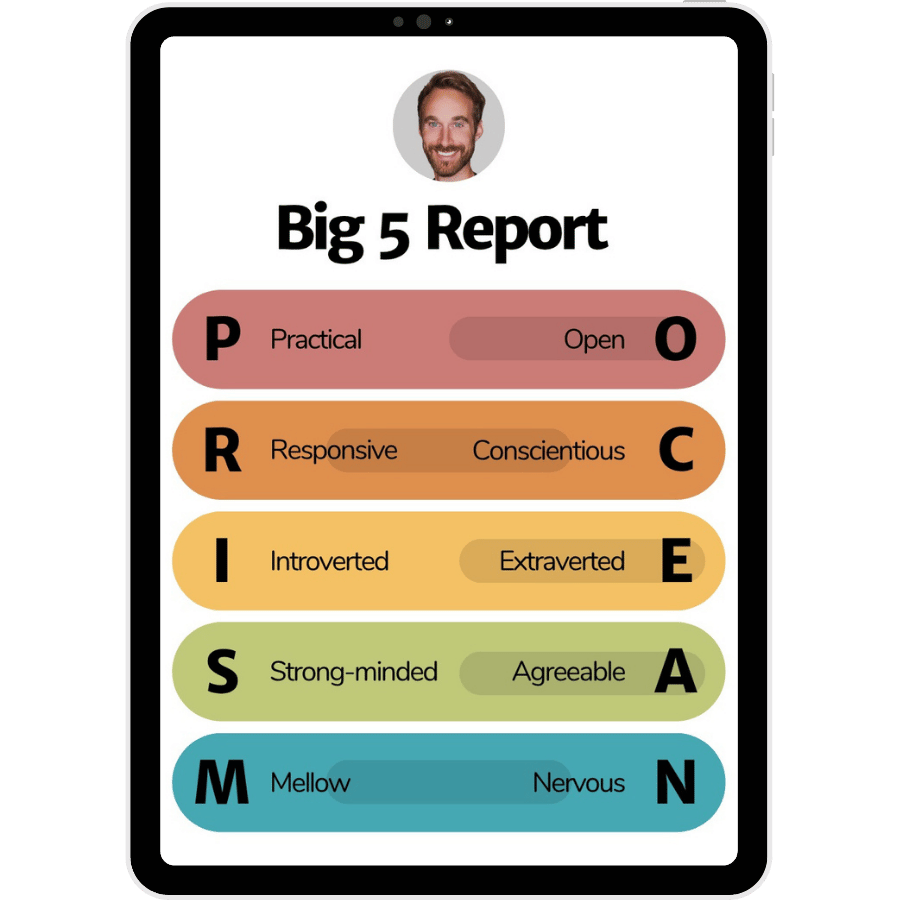
Now in a Simple, Effective and Easy to Use Framework
Explore our proven step-by-step method that's teachable in minutes










PRISM-OCEAN is the science backed alternative to Myers Briggs, DISC, and other typologies. I invite you to use this simple yet powerful tool to better understand yourself and others at work.
John E. Nelson
Author & Creator of PRISM-OCEAN
A Complete Overview of the Big Five Personality Traits
The Big Five, also known as the five factor model or simply "OCEAN" is the most scientifically backed personality framework in the world.
Although its research began 100 years ago, recent discoveries now make it the top choice by leaders, managers, teams, coaches, and organizations looking to use a more evidence-based approach with their people.

What is Personality?
It might be helpful to begin with defining what personality is not.
Personality is not your age, sex, gender, values roles, experiences, identity, culture, etc.
However:
Your personality shapes and is shaped by all of these factors.
The definition of personality:
Your characteristic patterns of thinking, feeling, and behaving.
In other words:
Personality describes the individual differences we have between each other.
Try our Free Big Five Personality assessment.
What is Big Five Personality?
Also called the Five Factor Model (FFM), the Big Five is:
A research-backed personality model that measures the universal personality traits that all humans share.
Through a combination of the dictionary, survey data, statistics (and of course humans) researchers and scientists now agree there are five distinct personality dimensions.
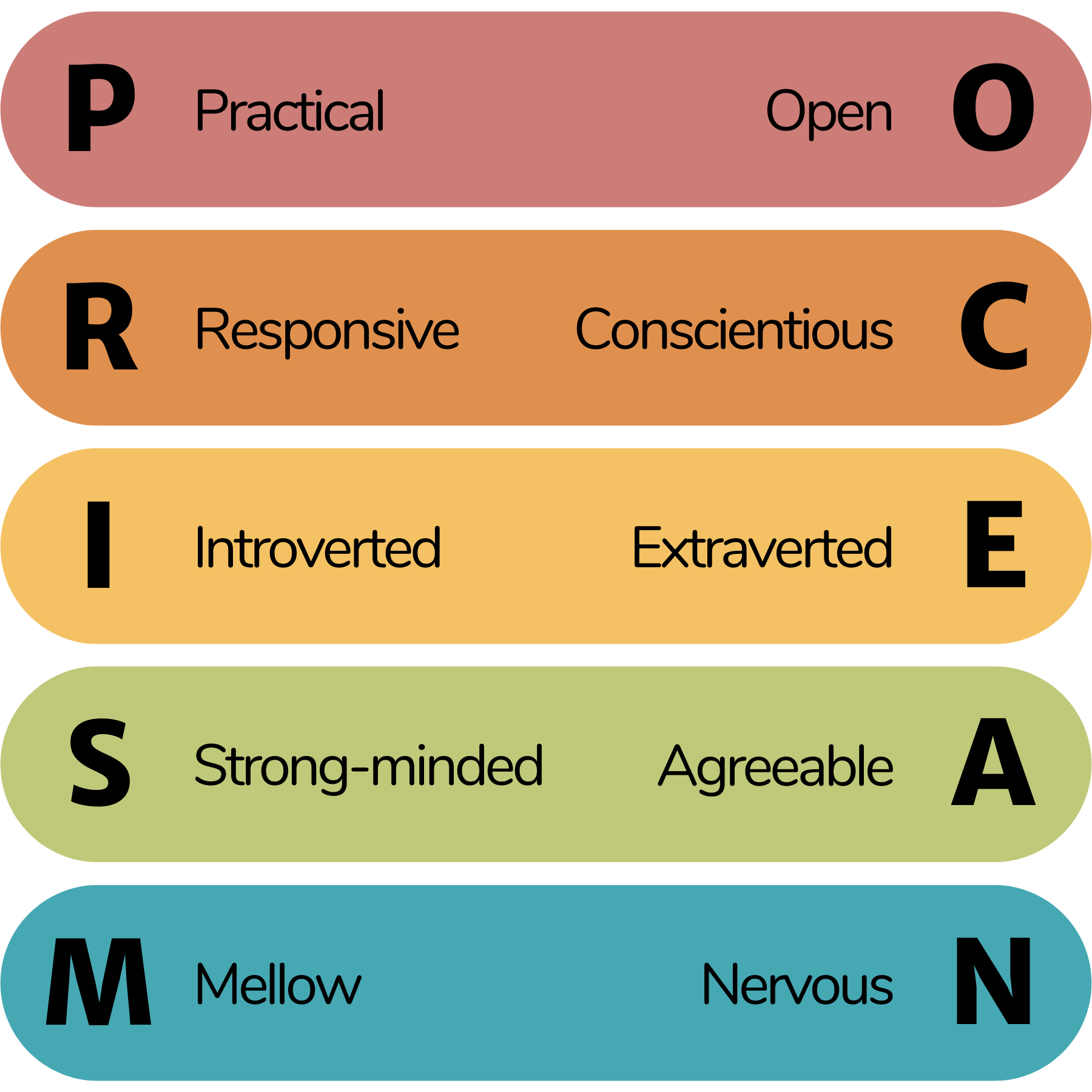
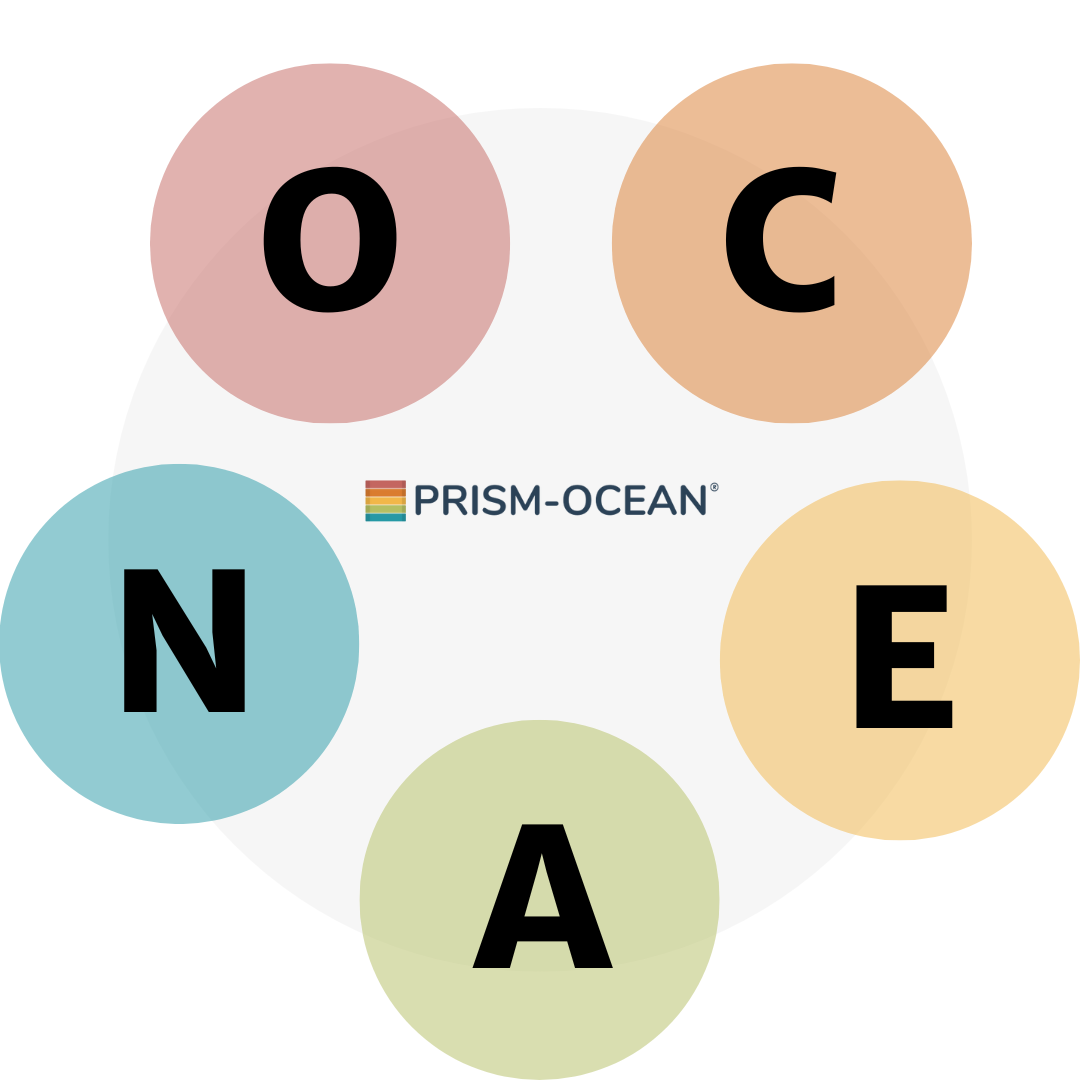
They spell the acronym OCEAN:
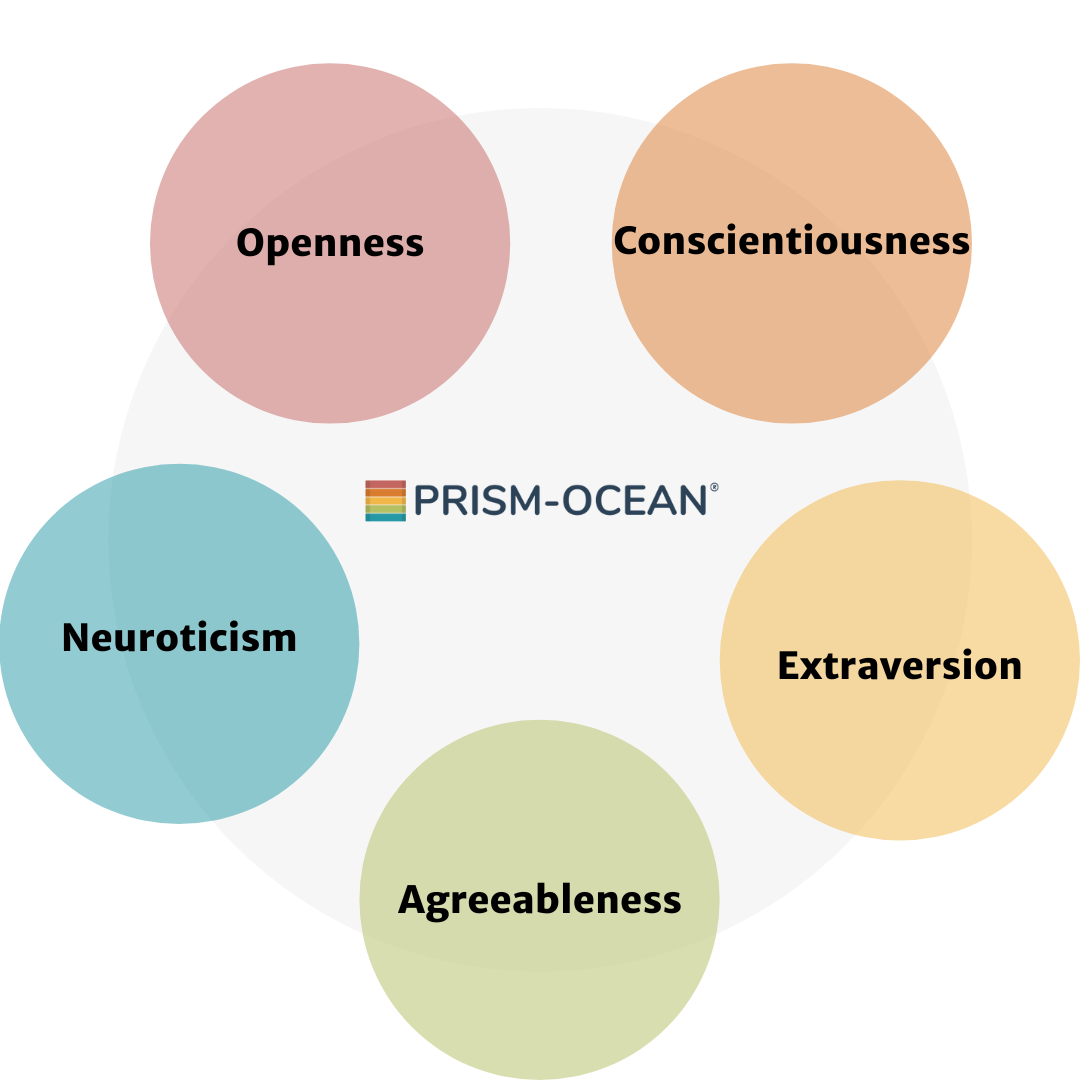
- Openness to experience
- Conscientiousness
- Extraversion
- Agreeablenss
- Neuroticism
Openness to Experience
The way you gather Information and how you use it.

Conscientiousness
The way you Control and order the world around you.

Extraversion
How much Activity and energy you use in the world.

Agreeableness
How much you Cooperate and collaborate with other people.

Neuroticism
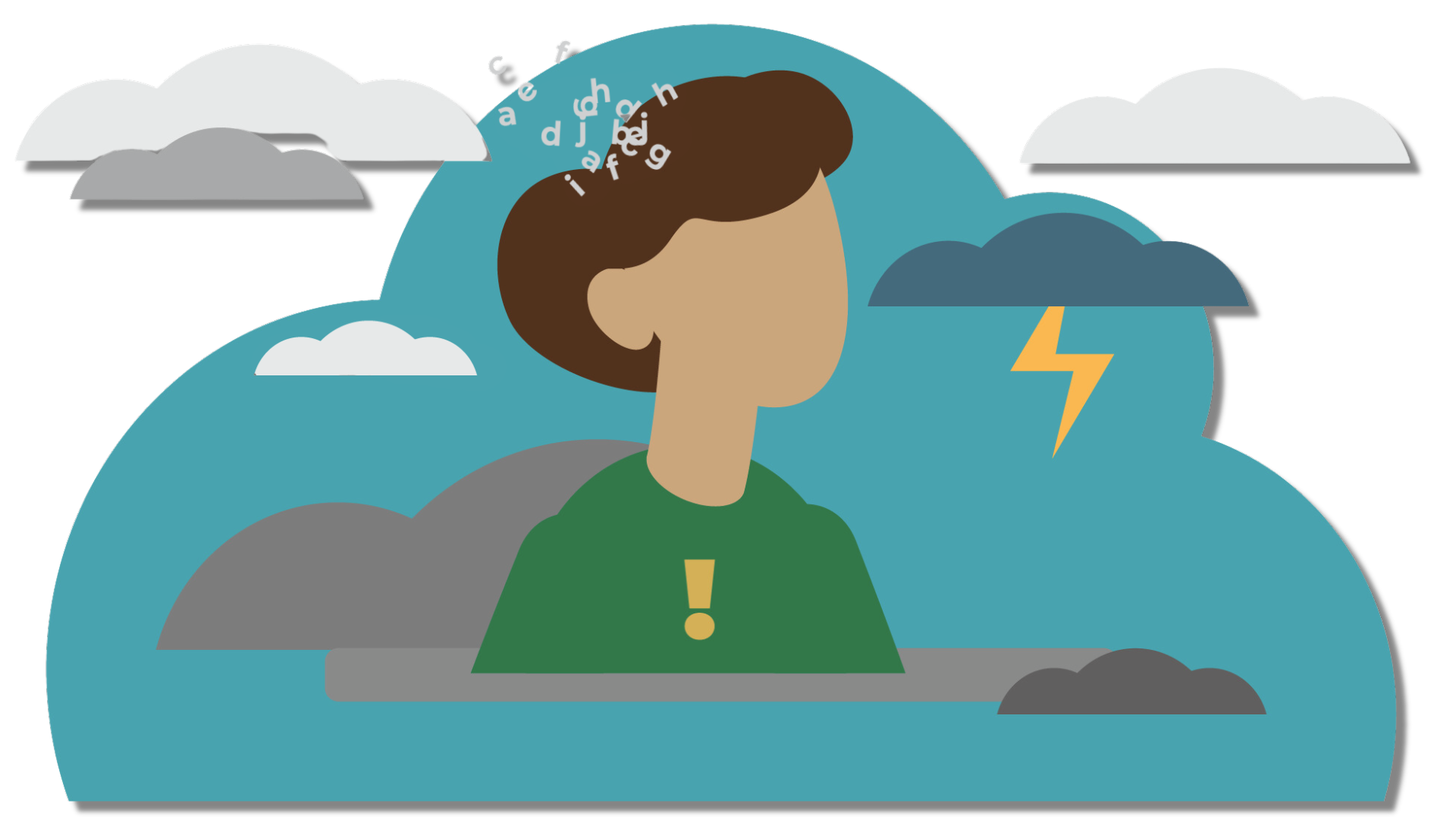
How your mind and body notices Threats and feels negative emotions.
Why is the Big Five Important?
Personality has been a topic of interest since the ancient Greeks.
Since then, psychologists have made many "guesses" as to what personality is. Some of these include the Myers Briggs, Enneagram, and DiSC.
Today, we don't need to make many guesses and can use language, research and experience to measure and define personality.
Put simply:
The Big Five is important because it gives us a shared personality model that's accurate, reliable, and valid.
Because:
You are not a "type"
You are not a "color"
You are not a "number"
You cannot be put into 4, or 9, or 16 different groups.
You have strengths and weaknesses
You are one of the most complex things in the universe and you deserve a better explanation of who you are than what's been given to you!
You are not defined by your personality, but your personality is an essential factor when starting to explain yourself and those around you.
Thousands of Published Research Papers
Big Five has the most published research papers of any personality model.
Big Five is used by Many Insitutions
The world's top universities, corporations, governments, and Silicon Valley have been using the Big Five to better understand you for years.
A few examples:
- IBM Watson
- NASA
- The Air Force
Pretty interesting, right?
In fact:
Large institutions have been using the Big Five to screen job applicants, train employees, segment consumers for marketing, target voters in political campaigns, and many other purposes.
What you can do:
Learn your own personality traits.
Your personality is your own, and we are here to help you better understand your personality so you can make more of your own decisions in life.
Big Five History (Timeline)
100 Years Ago
Curiosity prompted Gordon Allport to begin compiling the words we humans use to describe each other (lexical hypothesis). They started in the dictionary. The list was 4,504 words.
50 Years Ago
Advances in computing and statistics (factor analysis) allowed researchers to correlate these words to one another and boil down the list to 16 dimensions...
20 Years Ago
Sharing their findings in academic journals, separate research teams like Lewis Goldberg (IPIP) and Costa & McCrae (NEO) found these words could be organized into five broad personality domains: "The Big Five"
Today
Any and all researchers, academics, and scientists use the Big Five when they want to measure, understand, and explain individual human behavior.
Now the Most Accepted Personality Model
The Big Five is now the most widely accepted personality model among researchers, academics. scientists, and leaders.
Big Five OCEAN Traits
In this chapter, we’re going to cover what the the big five personality dimensions actually are, where they came from, and how to begin understanding them.
Question's Answered:
- What are Traits?
- Where do they come from?
- How do they work?

What are the Big Five Traits?
As you might remember, using factor analysis (a statistical method that correlates how related words are to other other words) researchers discovered these five traits (also called "dimensions" or "factors" or "systems" or "scales")
Here they are again:
- Openness to experience
- Conscientiousness
- Extraversion
- Agreeableness
- Neuroticism
Basically any adjective you would use to describe the thoughts, feelings, or behavior of someone falls into one of these five domains.
For example, think of someone you know, right now.
What are some words you would use to describe them?
Believe it or not, whatever words you just came up with can be categorized under one of the big five domains.
Take a look:
- "Curious" falls under Openness
- "Hard-working" falls under Conscientiousness
- "Kind" falls under Agreeableness
- "Lively" falls under Extraversion
- "Moody" falls under Neuroticism
Organizing our words into broad categories makes it much more useful to understand, define, and communicate with other people.
Traits, not Types
This is the most important breakthrough in personality research. Traditional (and outdated) personality models suggest that people can be neatly organized into "types".
Put simply, you are not a type and you cannot be put neatly into a box.
Instead:
You have consistent tendencies and patterns of thinking, feeling, and behaving a certain way. The Big Five just defines what these are.
Just like in evolution, there is a lot of diversity and variation in personality traits.
Being in the Middle is Normal
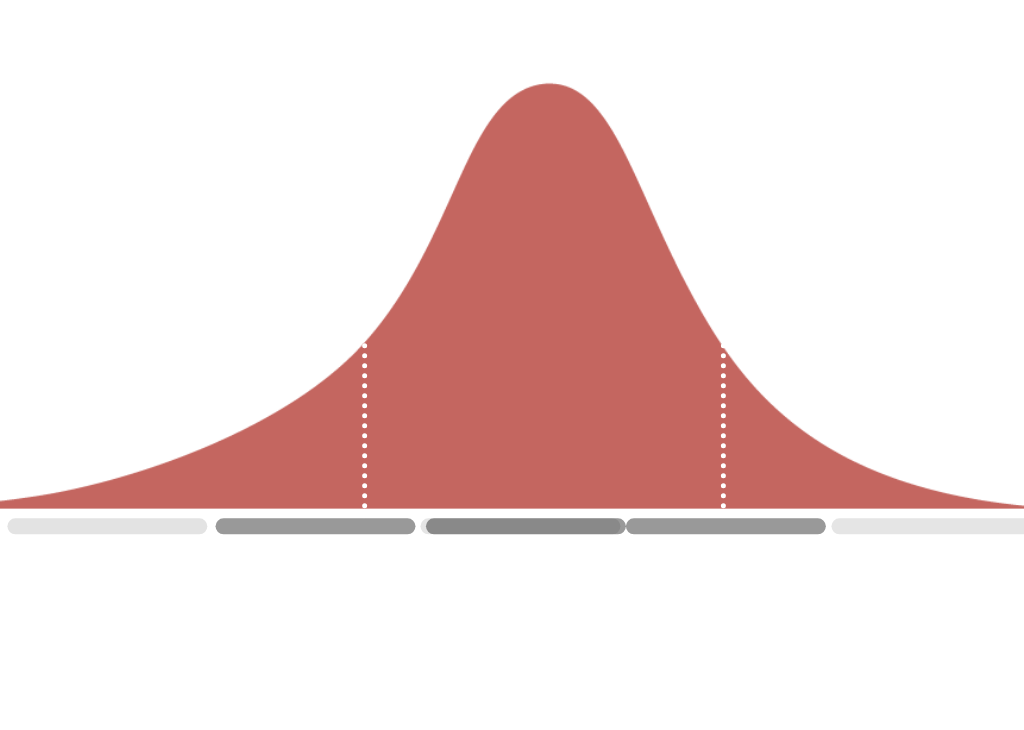
The second most important breakthrough in personality research is that the middle exists, and it's larger than you'd think.
Yes, it's possible to be extreme (high or low) on a trait.
But:
Most people are in the middle on any given personality trait.
When you take the entire population and plot them statistically, we all come out looking like a bell curve. Most people are somewhere in the middle,
What we've found:
You likely have one or two traits that you are higher or more extreme in.
You can be Situational
It's also very common for people to be "situational" with these traits.
For example, being introverted could be one of your strongest traits. You prefer quiet, low-key environments. But that doesn't mean you are introverted ALL of the time.
Rather:
If you are with your best friend, you are likely much more engaging and talkative. But if you are at a big party, you are likely more introverted.
The rule of thumb:
When the situation is strong, the situation dictates your behavior.
When the situation is weak, then your personality traits come out more.
Personality comes from your Genes
Nature vs nurture....
The most common "debate" since Darwin.
Today, we know that your initial traits come from your DNA aka your parents.
Just like you inherit your height, hair color, or eye color and many other traits.
But also:
Epigenetics has shown us that as you grow up, your traits interact with the environment, which continues to shape how your traits express themselves.
Your personal experiences will shape the traits you are born with.
Which brings us to...
Personality Can Change
Another hotly contested topic that's been debated for centuries...
Can you actually change?
YES!
Longitudinal research has shown that people's traits can change overtime.
Basically:
Your traits are stable, but not fixed.
This means they remain relatively the same throughout your lifetime, but they are not set-in-stone by any means.
Even though your traits are stable, you can change your personality traits through your environment, experiences, self-awareness, and deliberate action.
But first, let's start by learning what your traits are.
Learn Your Big Five Traits
In this chapter you will learn the basics of the PRISM-OCEAN personality traits.
Questions Answered:
- What is PRISM-OCEAN?
- Where can I take a free OCEAN test?
Start with Your Traits
There are many things that influence your behavior.
Such as:
Values, societal roles, jobs, life story, family, religion.
These are all very important!
But:
The best place to start learning about yourself is through your personality traits.