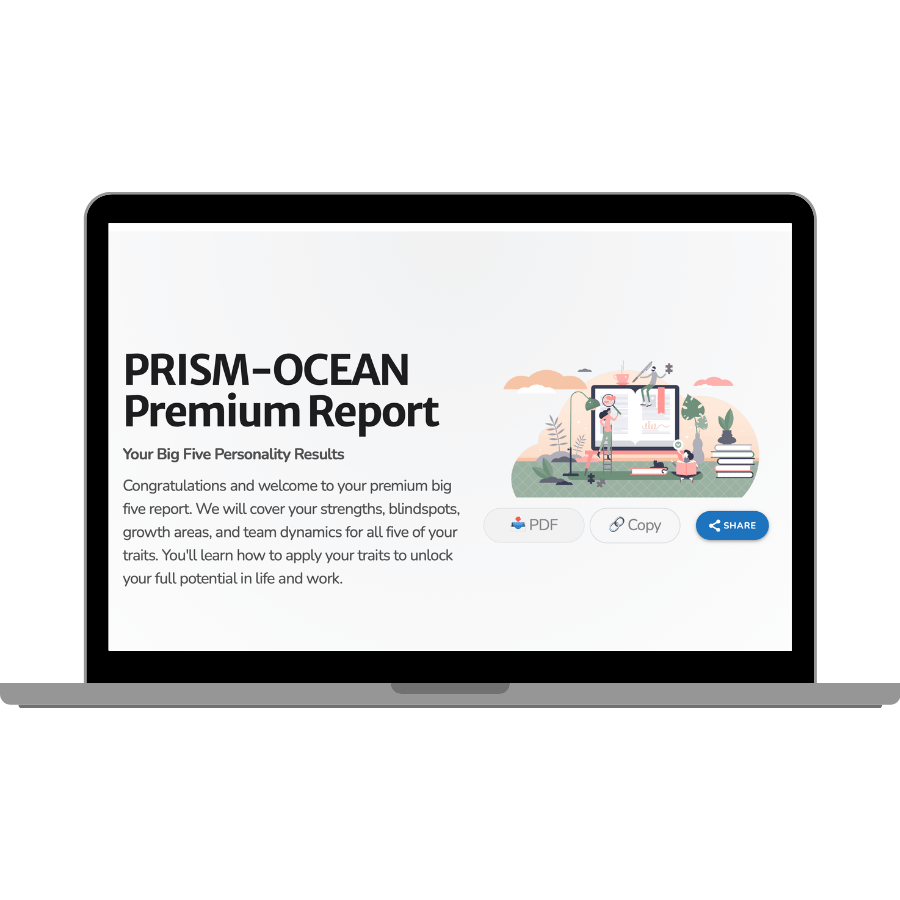
The Big Five OCEAN Personality Test
Take our personality test to assess your PRISM-OCEAN big five traits. No email required.
🕐 5 Mins
 Free Results
🕵️ Private
I have a vivid imagination



I avoid daydreaming
I see beauty in things that others might not notice
I find art museums uninteresting
I enjoy examining myself and my life
I pay no attention to emotions
I seek variety over routine
I prefer to stick with things that I know
I love to read challenging material
I avoid theoretical discussions
I like to tidy up
I leave my belongings around
I keep all of my commitments
I bend the rules
I set high standards for myself
I do the bare minimum
I start tasks right away
I find it difficult to get down to work
I am careful to avoid mistakes
I often make last minute plans
I make friends easily
I keep others at a distance
I talk to a lot of different people at parties
I prefer to spend time alone
I take charge
I wait for others to lead the way
I am always on the go
I like to take my time
I love excitement
I seek quiet
I believe that others have good intentions
I question people's motives
I love to help others
I don't like compromise
I hate to seem pushy
I like a good fight
I consider myself an average person
I believe that I am better than others
I feel sympathy for those who are worse off
I am not interested in other people's problems
I worry about things
I am relaxed most of the time
I get irritated easily
I am slow to anger
I often feel blue
I feel comfortable with myself
I tend to overindulge
I am able to control my cravings
I get overwhelmed by sudden life events
I remain calm under pressure
*Go with your gut, there are no wrong choices
What Is the Big Five Personality Test?
The Big Five Personality Test is the most scientifically validated tool for measuring human personality. Unlike other personality frameworks, the Big Five doesn't sort you into a fixed type or category. Instead, it measures where you fall on five universal dimensions of personality — giving you a nuanced, accurate picture of who you actually are.
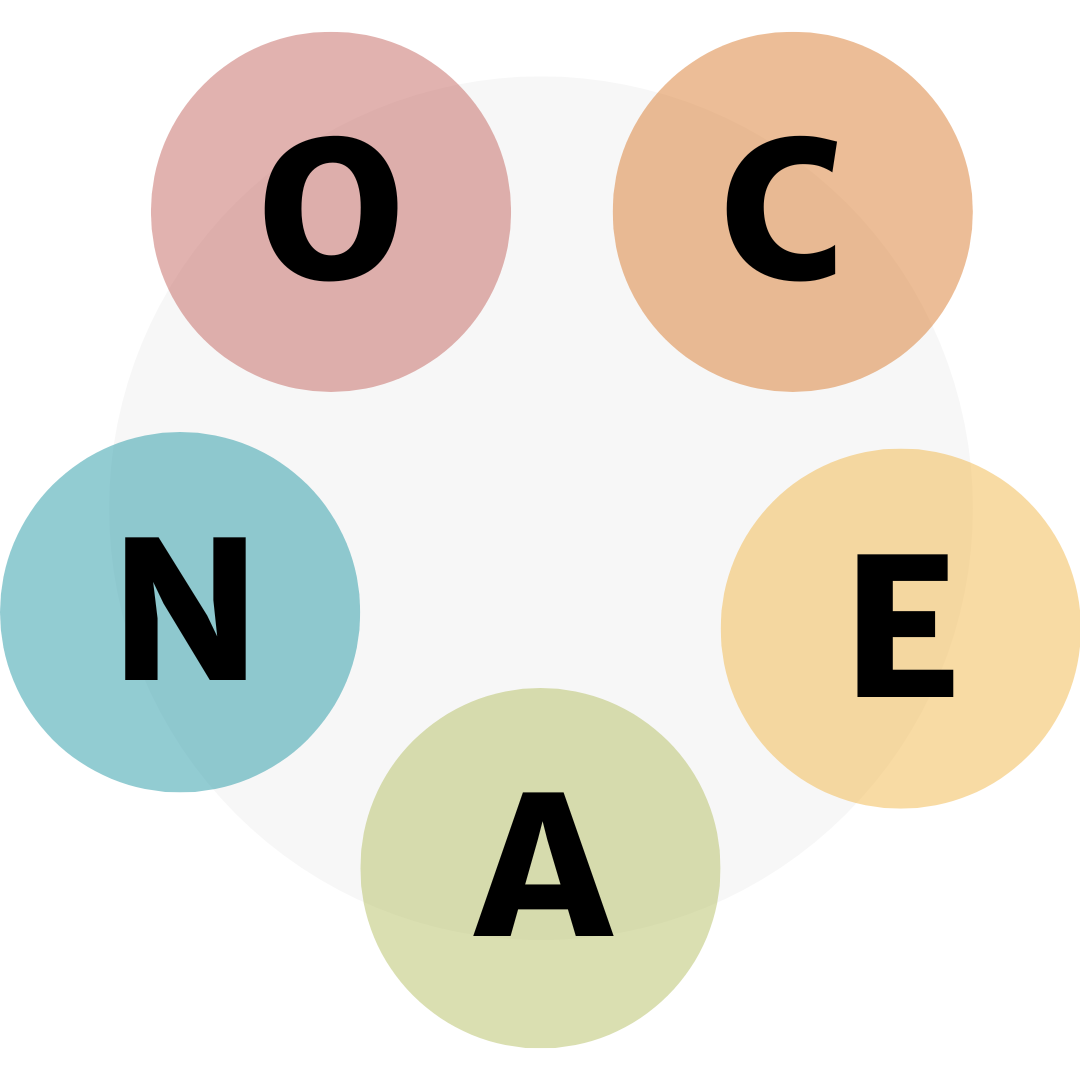
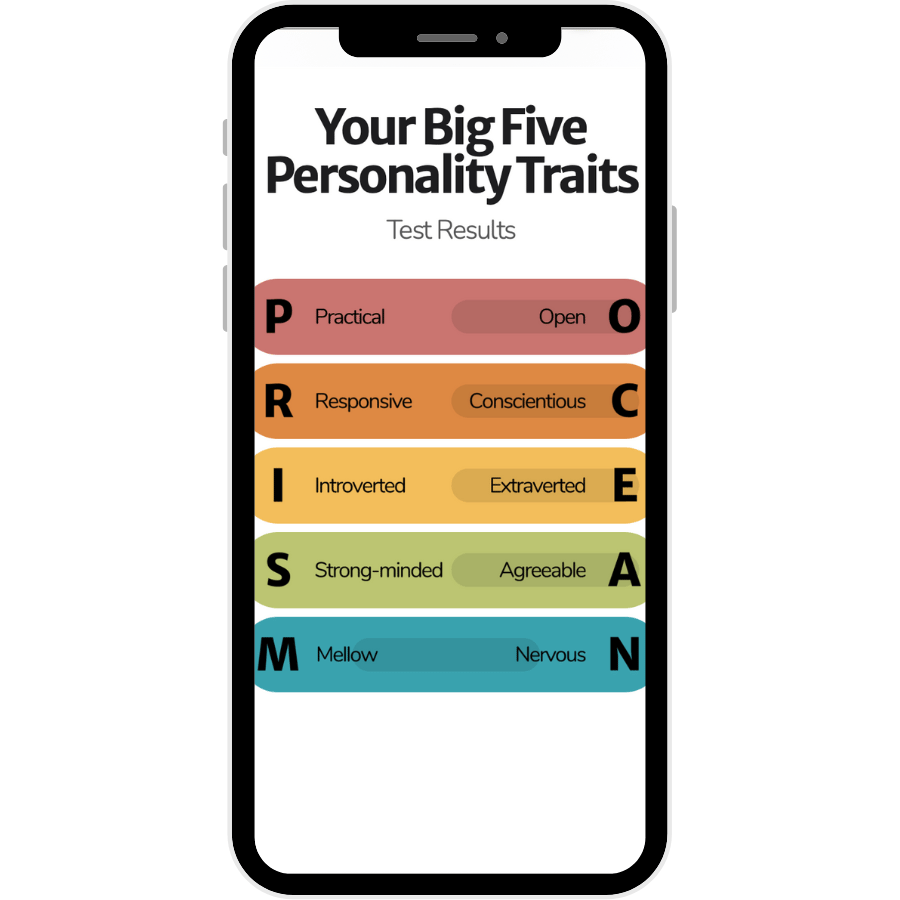
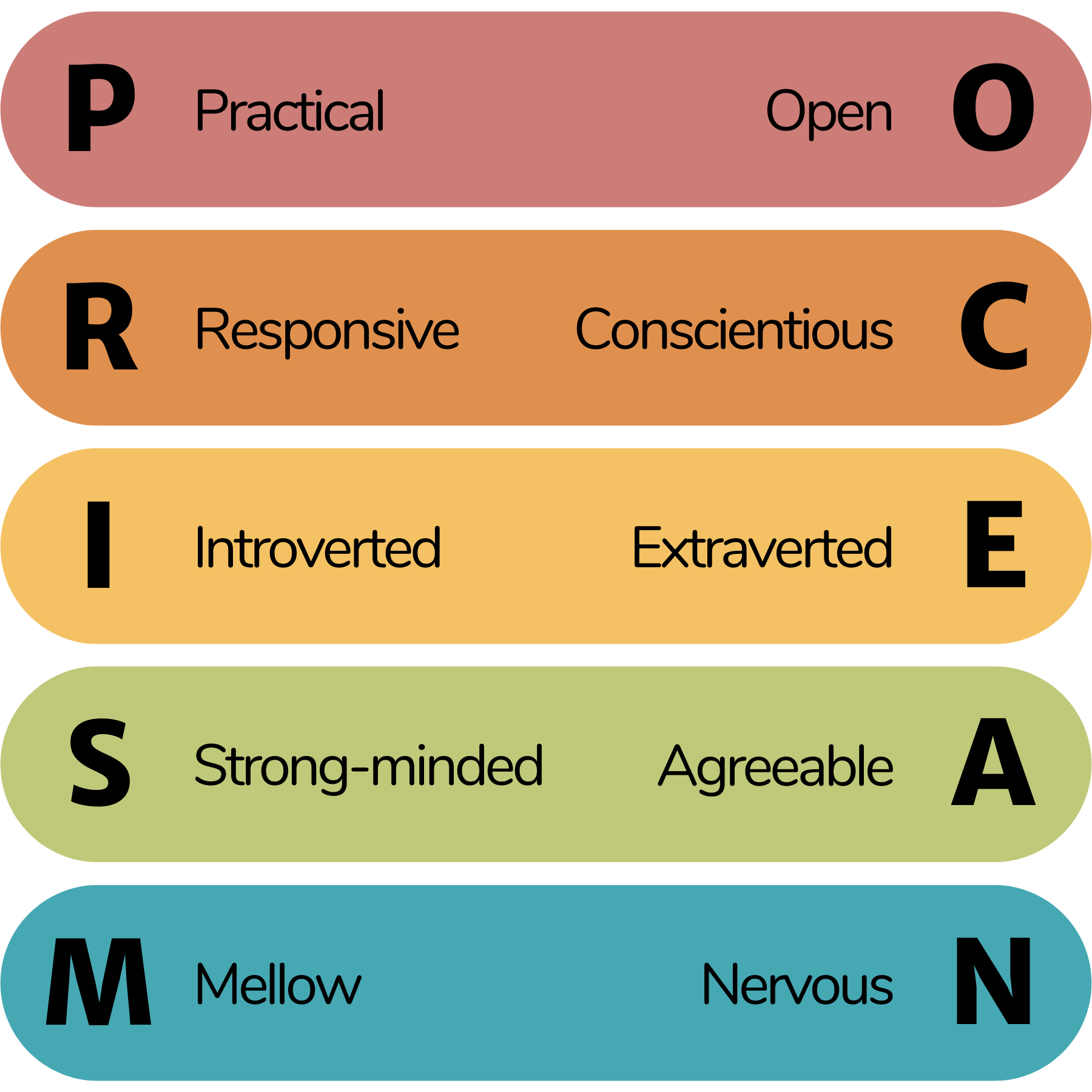
Those five dimensions are known collectively by the acronym OCEAN:
- Openness to Experience
- Conscientiousness
- Extraversion
- Agreeableness
- Nervousness
Each dimension represents a spectrum. Most people land somewhere in the middle on one or more traits, and that's completely normal. The value of the Big Five isn't in labeling you — it's in helping you understand your natural tendencies, how they shape your behavior, and how they show up in your work, your relationships, and your leadership.
For coaches, the Big Five provides a research-backed foundation for deeper client conversations. For managers and leaders, it offers a practical lens for understanding team dynamics, communication styles, and performance patterns. For individuals, it's simply one of the most honest mirrors available.
The PRISM-OCEAN test is built on decades of peer-reviewed research, adapted to be completed in just five minutes — without sacrificing scientific integrity.
The Science Behind the Big Five
The Big Five didn't emerge from a single researcher's insight or a corporate framework...
It was built slowly, rigorously, and collaboratively over nearly a century of scientific work — which is exactly why it holds up.
The story begins in the 1930s, when psychologists Gordon Allport and H.S. Odbert took a remarkable approach to studying personality: they went straight to the dictionary. Their hypothesis was that if a personality trait was important enough to humans, we would have invented a word for it. Scanning the English language, they identified over 11,000 trait-related terms.
That list was far too large to be useful. Over the following decades, researchers worked to distill it. Raymond Cattell reduced it to 16 factors. Hans Eysenck argued for just three. The debate continued.
It was Lewis Goldberg in the 1980s who gave us the framework we use today, formally naming and defining "The Big Five" personality factors. Goldberg's work was later reinforced by Robert McCrae and Paul Costa, whose NEO Personality Inventory became one of the most widely used assessment instruments in psychological research.
What followed was an extraordinary convergence. Researchers across different countries, using different languages and different methodologies, kept arriving at the same five factors. The Big Five wasn't just a clever model — it appeared to reflect something genuinely fundamental about human personality.
Today, the Big Five is backed by more than 50,000 peer-reviewed research papers. It is used by academic psychologists, organizational researchers, clinical practitioners, and leadership consultants worldwide. No other personality framework comes close to its scientific pedigree.
The PRISM-OCEAN assessment draws on validated instruments including the NEO Personality Inventory, the International Personality Item Pool (IPIP), and the Big Five Inventory (BFI), synthesized into a streamlined, accessible format that retains the psychometric integrity of the originals.
The Five OCEAN Personality Traits Explained
Understanding each of the five traits in depth is where the real value begins. Here is what each dimension actually measures, what high and low scores tend to look like in practice, and why each one matters in professional and coaching contexts.
1. Openness to Experience

Openness to Experience reflects the degree to which a person is intellectually curious, imaginative, and open to new ideas, perspectives, and ways of doing things. It is the trait most closely associated with creativity, learning agility, and comfort with ambiguity.
People who score high in Openness tend to seek out new experiences, enjoy abstract thinking, and are drawn to complexity. They often thrive in environments that reward innovation, strategic thinking, or creative problem-solving. In coaching contexts, highly open clients tend to engage deeply with self-reflection and are often receptive to reframing and new perspectives.
People who score lower in Openness tend to be more practical, conventional, and comfortable with structure and routine. This is not a weakness — it often correlates with reliability, consistency, and deep mastery of established methods. Many highly effective managers and operators score lower in Openness.
For leaders, Openness often determines how well someone navigates change, generates strategic vision, and builds cultures of psychological safety. For coaches, understanding a client's Openness score can shape how you introduce new frameworks, how much structure to provide, and how to frame growth challenges.
2. Conscientiousness

Conscientiousness measures the tendency to be organized, disciplined, dependable, and goal-directed. It is widely regarded as the single most powerful Big Five predictor of job performance across industries and roles.
People who score high in Conscientiousness are typically thorough, reliable, and self-motivated. They set goals and follow through. They manage their time well, hold themselves to high standards, and tend to be trusted by colleagues and employers alike. In leadership, high Conscientiousness often correlates with operational excellence and consistent execution.
People who score lower in Conscientiousness tend to be more flexible, spontaneous, and comfortable with improvisation. They may resist rigid processes but often bring energy, adaptability, and creative thinking to fast-moving environments.
For coaches, Conscientiousness is often central to conversations about accountability, habit formation, and follow-through. For managers, it helps explain why some team members need detailed structure while others perform best with autonomy and flexibility. Understanding this dimension alone can transform how a leader delegates and how a coach designs client commitments.
3. Extraversion

Extraversion measures where a person draws their energy — from social interaction and external stimulation, or from solitude and internal reflection. It is probably the most visible of the five traits and the most commonly misunderstood.
People who score high in Extraversion tend to be outgoing, assertive, and energized by social connection. They often gravitate toward leadership roles, enjoy collaboration, and are comfortable with visibility. They process their thinking out loud and tend to move quickly in social situations.
People who score lower in Extraversion — introverts — are not shy or antisocial. They simply recharge through quieter, more solitary activity. Introverts often bring deep focus, careful listening, and considered judgment to their work. Many of the most effective leaders and coaches are introverts.
The important framing here is the spectrum, not the poles. Most people are neither strongly extraverted nor strongly introverted — they're somewhere in the middle, adapting fluidly to context. The Big Five calls this ambiversion, and it's the most common position on the extraversion scale.
For coaches, Extraversion shapes how clients communicate, how they prefer to process feedback, and how they show up in group versus one-on-one settings. For managers, it informs meeting design, team communication norms, and which roles will naturally energize or drain different people.
4. Agreeableness

Agreeableness reflects the tendency toward cooperation, empathy, trust, and social harmony. It measures how much a person prioritizes getting along with others versus pursuing their own goals and perspectives.
People who score high in Agreeableness are typically warm, considerate, and skilled at building trust. They are often excellent collaborators, skilled at navigating conflict diplomatically, and attuned to the emotional needs of those around them. In coaching, highly agreeable clients often excel at building rapport but may need support in setting boundaries and advocating for themselves.
People who score lower in Agreeableness tend to be more direct, competitive, and comfortable with disagreement. This can manifest as strong negotiating ability, willingness to deliver difficult feedback, and resilience under conflict. In leadership contexts, moderate-to-lower Agreeableness is often associated with the ability to make tough decisions without being overly swayed by social pressure.
One of the most interesting dynamics in leadership research is the tension between Agreeableness and effectiveness. Highly agreeable leaders are often well-liked but may struggle with accountability conversations and difficult decisions. Lower-agreeable leaders may be decisive but risk being perceived as cold or insensitive. The most effective leaders tend to find a workable balance — direct and honest, but not callous.
For coaches and managers alike, Agreeableness is one of the richest traits to explore. It sits at the intersection of communication style, conflict navigation, empathy, and self-advocacy.
5. Nervousness

Nervousness — sometimes referred to in research literature as Neuroticism or Emotional Stability — measures the tendency to experience negative emotions such as anxiety, worry, self-doubt, and emotional reactivity. It reflects how consistently calm and stable a person feels in the face of stress, uncertainty, and challenge.
People who score higher in Nervousness tend to experience emotions more intensely and may be more sensitive to stress, criticism, and perceived threats. This is not a character flaw. High-Nervousness individuals are often deeply empathetic, conscientious about potential risks, and acutely aware of relational dynamics. In coaching, they frequently bring remarkable self-awareness to their work.
People who score lower in Nervousness tend to be emotionally resilient, calm under pressure, and less reactive to setbacks. They often project stability and are seen as reliable anchors in high-stress environments. In leadership, lower Nervousness is associated with composure, confidence, and the ability to think clearly in a crisis.
Nervousness is arguably the most important trait to discuss sensitively in coaching and management contexts, because it touches on emotional experience in a way the other traits don't. The goal is never to pathologize higher scores — it's to help people understand their emotional patterns, recognize their triggers, and build the self-awareness to respond rather than react.
For managers, understanding Nervousness across a team helps explain who needs reassurance during change, who handles ambiguity well, and how to structure feedback conversations to land productively rather than defensively.
How the Big Five Compares to Other Personality Models
The personality assessment landscape is crowded. MBTI, DISC, Enneagram, StrengthsFinder, and dozens of other frameworks compete for attention in professional development and coaching contexts.
Understanding how the Big Five fits into this landscape — and why it occupies a different category — matters for anyone using personality data professionally.
Big Five vs MBTI
The Myers-Briggs Type Indicator is perhaps the most widely recognized personality framework in the world. It is also one of the most criticized by academic psychologists. MBTI assigns people to one of 16 discrete types based on four binary dimensions. The core scientific criticism is that it forces continuous traits into categorical boxes — you're either an I or an E, a J or a P — when the evidence suggests personality actually exists on a spectrum.
Research has also raised questions about MBTI's test-retest reliability. Studies have found that a significant proportion of people receive a different type when retested just weeks later.
The Big Five avoids these problems by design. It measures five dimensions as continuous spectrums rather than binary types, and its results are highly stable over time. In academic psychology, the Big Five is the standard. MBTI, despite its cultural popularity, is rarely used in peer-reviewed research.
That said, MBTI has genuine value as a communication tool and a starting point for self-awareness. It simply shouldn't be used as a predictive or diagnostic instrument in the way the Big Five can be.
Big Five vs DISC
DISC is widely used in corporate training and organizational development. It measures four behavioral styles — Dominance, Influence, Steadiness, Conscientiousness — and is particularly popular for team communication and sales training.
DISC is practical and accessible, and it does a good job of describing observable workplace behavior. Its limitation is scope — four dimensions capture far less of the personality landscape than five, and DISC was designed primarily for workplace behavior rather than as a comprehensive personality model.
The Big Five and DISC share some conceptual overlap (DISC's Dominance maps loosely onto Big Five Extraversion and Agreeableness, for example), but the Big Five provides significantly more predictive depth for outcomes like job performance, leadership effectiveness, and personal development.
Many coaches and organizational practitioners use DISC for quick team workshops and the Big Five for deeper individual assessment work. They serve different purposes and are not truly in competition.
Big Five vs Enneagram
The Enneagram assigns people to one of nine personality types, each with associated subtypes, wings, and growth paths. It has a devoted following in coaching and spiritually-oriented personal development communities.
The Enneagram's strength is its narrative richness — it offers compelling frameworks for understanding motivation, fear, and interpersonal patterns. Its weakness is scientific validation. The Enneagram lacks the empirical foundation of the Big Five and its theoretical origins are contested.
For coaches who use the Enneagram, the Big Five can serve as a complementary tool — providing the empirical grounding that the Enneagram doesn't offer, while the Enneagram provides motivational and narrative depth that the Big Five doesn't emphasize.
Why the Big Five Is the Academic Gold Standard
The Big Five's dominance in academic psychology comes down to three things: it was derived empirically rather than theoretically, it has been replicated across cultures and languages consistently, and it has demonstrated predictive validity for real-world outcomes including job performance, relationship satisfaction, health behaviors, and life outcomes.
No other personality framework has this combination of empirical derivation, cross-cultural replication, and predictive validity at scale. For professionals who need to stand behind the tools they use, the Big Five offers a level of scientific credibility that other frameworks simply cannot match.

How to Use Your Big Five Results
Understanding your Big Five profile is one thing. Knowing what to do with it is where the real value lives. Here is how coaches, managers, and individuals can apply Big Five results meaningfully.
Big Five in Coaching
For coaches, the Big Five provides a structured, objective foundation for self-awareness work that can otherwise take months to surface through conversation alone. A client's Big Five profile quickly illuminates their natural strengths, potential blind spots, and the contexts where they're most likely to thrive or struggle.
Practically, the Big Five helps coaches tailor their approach. A client high in Openness and low in Conscientiousness needs different accountability structures than one who is highly conscientious but low in Openness. A client high in Nervousness needs the coach to be particularly thoughtful about how feedback is framed and how growth challenges are introduced.
The Big Five also opens up productive conversations about patterns clients may not have language for. Many people intuitively know they're more introverted, or that they tend toward anxiety, but haven't connected those tendencies to their professional choices, relationship patterns, or leadership style. The Big Five gives both coach and client a shared vocabulary to work with.
Used well, the Big Five doesn't tell a client who they are — it opens a door to a deeper conversation about who they're becoming.
Big Five in Management and Leadership
For managers and leaders, the Big Five offers something particularly practical: a way to understand the people on your team without projecting your own preferences onto them.
Most management problems are, at their core, personality mismatch problems. The manager who values autonomy manages a team member who needs structure. The leader who processes out loud frustrates a team member who needs time to think quietly before responding. The Big Five makes these differences visible and discussable rather than a source of silent friction.
Specifically, the Big Five helps managers with team composition — understanding which trait combinations tend to work well together on different types of projects. High-Conscientiousness team members often pair well with high-Openness creatives, balancing innovation with execution. Knowing this in advance helps with project staffing.
It also helps with feedback and communication. Understanding a team member's Agreeableness and Nervousness scores, for example, can inform how you structure a performance conversation to ensure it lands as developmental rather than threatening.
For leadership development, the Big Five is increasingly used to identify growth edges. A leader high in Extraversion and low in Agreeableness may need to develop their listening skills. A leader high in Conscientiousness and low in Openness may need support in embracing strategic ambiguity. These are not deficiencies — they are development priorities, and the Big Five makes them concrete.
Big Five in Personal Development
Beyond professional contexts, the Big Five is simply one of the most honest tools available for personal self-understanding.
Your trait profile can help explain patterns in your relationships — why you're drawn to certain people, why certain dynamics keep repeating, why some environments energize you and others drain you. It can inform career decisions, helping you identify roles and cultures that are naturally aligned with who you are versus those that require constant adaptation.
Perhaps most usefully, the Big Five helps you distinguish between who you are and who you've been conditioned to perform. Many people suppress natural tendencies — an introvert who has learned to perform extraversion in a social culture, a high-Nervousness person who has been told to "just relax" — and the Big Five can be a starting point for reclaiming a more authentic and sustainable way of operating.

How to Interpret Your Big Five Score
Your Big Five results place you on a spectrum for each of the five traits. Here is how to read those results accurately.
Each trait score reflects where you fall relative to the general population. A high score means you tend more strongly toward one end of the dimension. A low score means you tend toward the other end. A mid-range score — often the most common — means you are flexible across both poles depending on context.
There are no good scores or bad scores. Every position on every spectrum has genuine strengths and genuine growth edges. High Conscientiousness brings reliability but can tip into rigidity. High Agreeableness brings warmth but can tip into people-pleasing. High Openness brings creativity but can tip into distraction. The goal of the Big Five is not to rank you — it's to describe you accurately.
A few common interpretation mistakes worth avoiding: don't treat your scores as fixed labels. Research suggests that while Big Five traits are relatively stable across adulthood, they do shift gradually — particularly Conscientiousness and Agreeableness tend to increase with age. Your scores today are a snapshot, not a life sentence.
Also, resist the urge to explain away scores that surprise you. If your Extraversion score is lower than you expected, don't dismiss it — sit with it. The Big Five often reflects tendencies we've overridden through learned behavior, and those surprises are frequently the most useful data points.
Finally, read your profile holistically. The five traits interact. A high-Extraversion, low-Agreeableness combination looks quite different from a high-Extraversion, high-Agreeableness combination. Your full OCEAN profile is richer than any single trait score in isolation.
📝 Frequently Asked Questions
Yes — the Big Five is the most empirically validated personality model in academic psychology. Its accuracy has been confirmed across thousands of studies, multiple countries, and diverse populations. When taken honestly, it consistently produces results that are stable over time and predictive of real-world outcomes including job performance, relationship quality, and health behaviors.
About the PRISM-OCEAN Big Five Personality Test
The PRISM-OCEAN test was built on a simple premise: the world's most scientifically validated personality model shouldn't require a 40-minute questionnaire, a clinical interpreter, or a confusing percentile chart to be useful.
We synthesized decades of Big Five research from validated instruments including the NEO, IPIP, and BFI into a 50-item assessment that takes five minutes and produces results you can actually read and use. Our free test gives you an accurate, accessible overview of your five trait dimensions. Our premium reports go deeper — covering strengths, blind spots, growth edges, and team dynamics in a format built for coaches and professional contexts.
No email required to start. No jargon. No types. Just an honest, research-backed picture of who you are.